

In this blog, learn how to go on offense following a regulatory compliance audit or inspection, so you’re well-prepared for the next one. Using sports training analogies, the authors present a better way to handle ongoing inspections and audits in healthcare systems.
If you play us in basketball, we’re going to run the fast-break transition offense at you, and we will tell you right now; you don’t want to play us two on two. We know our biggest strength – namely that conditioning kills. Savage speed plus unlimited endurance equals an unstoppable force.
The fast-break transition offense we use is inspired by the 1990 UNLV Running Rebels basketball team. This high-tempo strategy aims to score before the defense can get set. It involves pushing the ball down the court immediately after gaining possession and creating scoring opportunities through numerical advantages and defensive mismatches.
You can apply the same strategies when managing audits and inspections.
What Drives Healthcare Audits and Inspections?
Audits and inspections are regular occurrences in healthcare systems. A number of factors influence how often and what kind.
- Internal vs. External: Healthcare organizations conduct their own internal audits monthly, quarterly or annually.
- Regulatory Bodies: Government agencies conduct their own audits, with the number depending on things like budget and staff.
- Risk and Regulation: Frequency may increase if issues are discovered or when major changes are made to regulations.
- Organization Size: Larger organizations often have more complex auditing needs, potentially driving more frequent audits.
- Staff Turnover: High turnover can trigger more frequent audits to ensure consistency.
What’s Your Playbook for Regulatory Inspections and Audits?
Most healthcare systems have good reason to believe that a regulatory inspection, sponsor audit or other scrutiny could appear at any time, announced or unannounced. It’s accepted that the standard technique for managing these visits is ongoing vigilance.
At her presentation on “How to Be Your Own Internal Monitor: A Guide to Monitoring Your Own Studies” at the ACRP 2025 conference, Ann-Marie Jacobson, CCRP, Senior Research Affairs Specialist at Tufts University School of Dental Medicine, said “Because of the unknowns about inspections and audits of in-progress or completed clinical trials, it is important to make sure that all study materials are always kept accurate, current, and explanative of the study activities to date.”
“You always need to be asking yourself, if the Food and Drug Administration (FDA), sponsor, or IRB came in right now and selected a current or recently closed study for examination, would everything be ready?”
She explained that at her institution, study coordinators “regularly conduct audits of regulatory binders, subject folders, case report forms (CRFs), payment logs, and enrollment/screening logs. These are coordinators who are separate from the clinical team, to ensure that fresh perspectives are always present.”
We don’t disagree with her, but we wouldn’t call that a fresh approach. Rather, we think that ongoing vigilance should be the standard in healthcare compliance, like a basketball team needs the fundamentals of solid shooting, dribbling and passing.

Changing Audit Landscape Requires a New Game Plan
The current healthcare audit landscape is shifting and shifting quickly. Back in late 2024 and even earlier this year, federal and state auditors would arrive and investigate one complaint at a time. They’d come in specifically for one reason or to investigate a particular incident, talk with a couple of staff members, and then summarize their findings and leave.
Now, we’re hearing differently. Just this week at one of our collegial facilities, an investigator came in to investigate about 10 complaints in various areas, from documentation, to patient care and the like.
To diligently investigate complaints of this type and volume, the auditor or inspector is probably going to be there on-site for a week or more. They will gobble up valuable conference room space, staff time and basically throw your whole operation into a tizzy due to the heightened emotional state.
What’s your game plan for audit readiness now?
Fast Break Offense for Compliance Audit Readiness
How do you combat this? Well, if you use the key principles of a fast break offense, you will be prepared and conditioned. We’ve adapted these three techniques to the compliance game, to make champions of your team.
1 – Push the Pace
In basketball, coaches encourage players to maintain a fast pace and recognize when to initiate the first trigger. In an audit, this means anticipating what the auditor is going to ask and getting ahead of it before they bring it up.
Pre-audit prep meetings and ongoing reviews of your events make this work, but you can’t just do a pre-audit meeting when an inspection is scheduled. You need to regularly schedule pre-audit meetings, so you’re always prepared.
I know most organizations don’t do this. But we do. Which is why we have covered things so thoroughly that we can go quickly and get the auditor what they need and then move on to the next question.

2 – Strength in Numbers
In sports, we recognize numerical advantages, such as 2-on-1’s, 3-on-2’s or 4-on-3’s and then capitalize on these circumstances through drive-and-kick sequences. Drive the ball to the basket and when the defense collapses on the person with the ball, you kick the ball out to an open teammate to hit a jump shot.
Within audits, scoring means answering auditors’ questions with the best players you have. You create a numerical advantage by bringing in multiple people to meet with the auditor at the same time and kicking facts around like you would move the ball to score.
3 – Continuously Practice Good Habits Across the Team
Lastly, you need elite conditioning habits in sports and in compliance. To run the fast break effectively, you can’t get tired. Imagine unleashing an endless barrage of offense and staying so diligent to this effort that teams know it’s coming and still can’t stop it.
The team with the most dialed-in offense is usually the most capable, but you need to have players who can react “lag-free” or win their first three steps to capitalize on numerical advantage. The only way to get good at this is to continually work on it.
Quality and compliance preach continuous improvement, but how often do you do make the effort? How often do you stay late at work, just because? How often do you run more meetings or make everything tighter?
Chances are zero times, but I will tell you right now that we do. So, if you get into an audit with me, by Day 4, I am still working with a full gas tank, but the auditor isn’t because they went home and “Netflixed“ while I slept. Get your whole team committed to elite habits, and you are unstoppable.
Prepare Your Compliance Program for the Win
By reinforcing these principles and working on conditioning and decision making, teams can create more scoring opportunities. And just as a prepared team can force the defense into difficult situations, a well-prepared compliance team can “force” the auditor into zero-findings and more quality inspections.
Download a PDF Version of the Tip Sheet
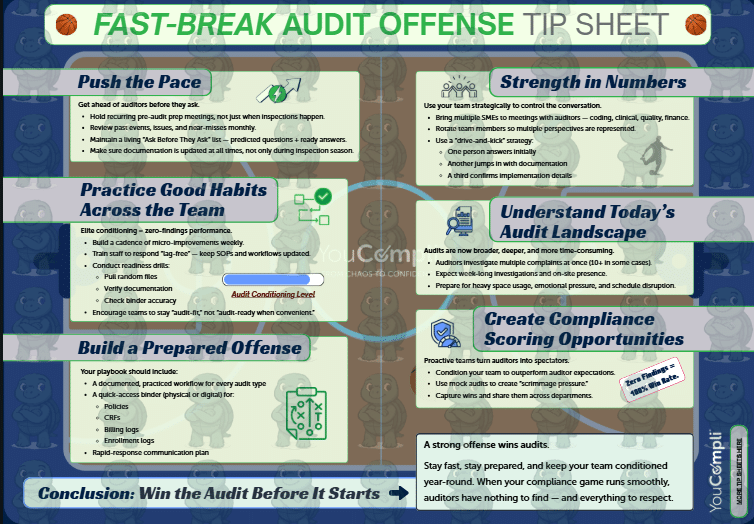
Create Compliance Scoring Opportunities
If you’re interested in more ideas for building a strong compliance program, read these resources next. A strong compliance culture is the foundation of a strong program.
10 Tips for Building a Compliance Culture in Healthcare
Earning recognition as a value creator and establishing a healthy culture can be challenging. Yet as these 10 tips show, you can successfully shape culture to help the larger organization better manage and control risk.
Healthcare Compliance Culture Means Doing the Right Thing at All Levels
A culture of compliance isn’t just a platitude. It really does exist. Those organizations with a strong culture of compliance and an effective compliance program are the ones with engaged clinical and operational leaders.
A Culture of Compliance Through Proactive Decision-making
A culture of compliance is critical to effective regulatory change management. Find three steps to help your leaders make decisions more proactively.

Andrea has taught first grade in Willoughby, Ohio for 27 years in the same classroom that she attended school as a child. She earned a Bachelor of Science in elementary education with a minor in language arts from John Carroll University and a Master’s Degree in the Art of Teaching and Education from Marygrove College.

John builds and fixes quality departments, while currently thriving as the Administrator & Director of Quality, Risk Management and Compliance at River Vista, a behavioral hospital in Columbus, Ohio.
The Q-Kids – John R Nocero and Andrea L Bordonaro – are experts at everything quality, regulatory, education training and compliance and love sharing their knowledge on YouCompli.
Follow them on LinkedIn – for more quality content or send them a message – they’d love to hear from you.
Download our Latest Whitepaper

Sign-up for our Weekly Newsletter
Schedule a quick overview

27 Ungated Resources for Compliance Leaders and Teams
Compliance professionals sometimes feel undervalued in comparison to other functions in their organization. They think leaders and colleagues don’t really understand what they do.
These resources will help. Packed with ideas, tips and recommendations, these pieces were written by professionals with many years of compliance experience.
You can quickly skim for articles that relate to your needs and interests. Bookmark this page as a reference for future questions or projects.