

About the Medical Necessity Series
This is the third in our series of articles on medical necessity. In the first, we described the compliance risks associated with submission of claims for medically unnecessary services.
In the second, we highlighted a case where an organization of long-term care hospitals were alleged to have violated the Federal False Claims Act (FCA) for holding patients in the hospital longer than medically necessary to increase reimbursement from Medicare.
In this next article, we spotlight another recent example of a healthcare provider entity agreeing to pay a six-figure sum to resolve allegations of submission of claims for medically unnecessary services1. This time, the providers consisted of three affiliated skilled nursing facilities (SNF) that were alleged to have submitted claims for medically unnecessary rehabilitation services.
False Claims Act Metrics Make Significance Clear
The Department of Justice has reported that False Claims Act settlements and judgments reached $6.8 billion in Fiscal Year 2025. Over $5.7 billion of that total was derived entirely from the healthcare sector. Most of these healthcare recoveries stem from whistleblower lawsuits targeting corporate billing schemes, upcoding, and medically unnecessary services.
Case Involves SNF Reimbursement Dispute Over Therapy Services
For the period in question, skilled nursing facilities (SNFs) were reimbursed for therapy services based on a patient’s resource utilization group (RUG). The RUG was determined by the amount of services the patient received, such as:
- Physical therapy
- Occupational therapy
- Speech pathology services
In short, the more services provided, the higher the reimbursement. However, as discussed in our two prior articles, if the services don’t meet medical necessity requirements, they should not have been performed or billed in the first place.
Whistleblower Lawsuit Triggers Investigation
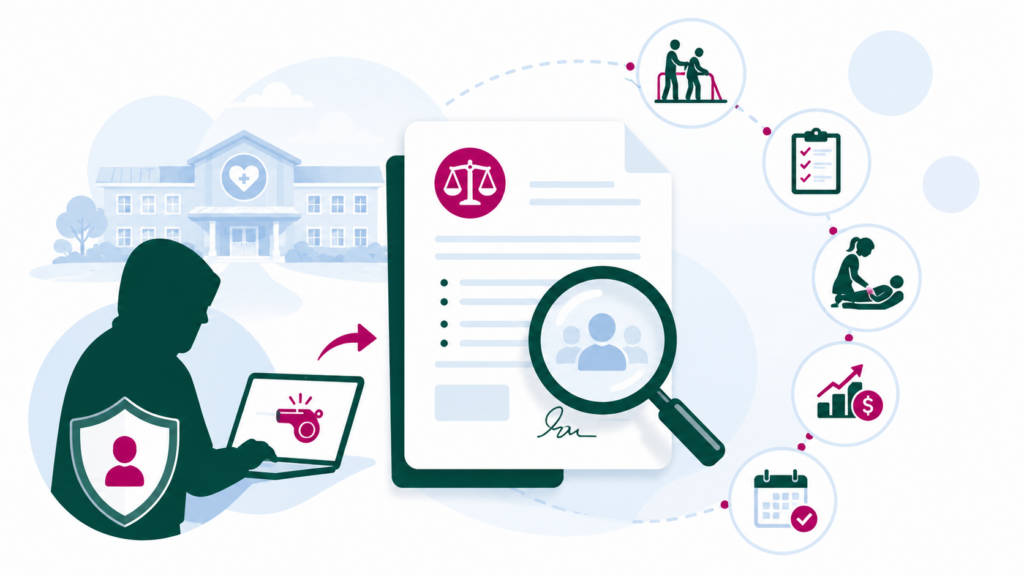
As is frequently the case, these allegations were first brought forth through a qui tam, or whistleblower, lawsuit. The whistleblower, or relator, claimed the defendants implemented a five-pronged scheme to fraudulently bill for unnecessary “Ultra High Rehab,” (the most intensive therapy provided by SNFs) and to keep patients in Ultra High Rehab for longer than necessary.
The five prongs of the alleged scheme were:
- Pressure to perform excessive, unnecessary services: The organization’s leadership exerted pressure on therapy staff to administer excessive Ultra High Rehab and to do so for longer than necessary.
This pressure was exerted not only by administrators who oversaw SNF operations, but also by regional directors of operations who managed the facility administrators. Such pressure was also exerted by directors of rehab (DOR) who managed therapists at each facility, and regional managers who directly managed the DORs.
In other words, management, from top to bottom, spoke to therapists and staff in one voice: increase Ultra High Rehab, regardless of patient need.
- Financial vs. medical reasons to provide care: Instead of letting therapists determine the appropriate level of therapy needed based on their professional evaluation, leadership insisted that each patient’s level of therapy be at least in part determined by whether the patient qualified for lucrative Medicare Part A benefits.
- Care for functional patients: The organizations pressured therapists to continue providing therapy to patients who were fully functional and in no way required intensive therapy. A scheme called “Bridge to Success” was employed which mandated an additional week of Ultra High Rehab be tacked on even after patients were ready for discharge.
- Too sick for care: The organizations pressured therapists to provide therapy to patients who were too sick to benefit from therapy and even to patients who were actually harmed by it.
Since therapy minutes were dictated by management and not assigned based on the professional opinion of evaluating therapists, patients ended up receiving more therapy than they could tolerate, including instances where therapy was forced on patients about to pass away.
- Maximizing minutes: The focus on maximizing therapy minutes to hit therapy goals also resulted in leadership encouraging an array of fraudulent billing practices.
This included:
- Billing non-therapeutic minutes as therapy
- Allowing therapists to bill for therapy without actually providing it
- Encouraging therapists to bill evaluation sessions as therapy.
Widespread Occurrences Involve $14.6+ Billion in Alleged Intended Losses
Federal enforcement actions emphasize the commonality of these practices. The 2025 National Health Care Fraud Takedown alone resulted in criminal charges against 324 defendants nationwide, involving over $14.6 billion in alleged intended losses tied to fraudulent billing and medical necessity abuses.
The most compelling argument for compliance leaders is that medical necessity fraud carries dual liability:
- Financial Risk: Organizations face mandatory treble damages (three times the government’s actual loss) plus steep statutory penalties for every individual false claim submitted.
- Human Risk: Unlike administrative billing errors, medical necessity fraud directly compromises patient care. Overutilization exposes vulnerable patients to unnecessary, exhausting or potentially harmful procedures simply to satisfy corporate revenue targets.

Three Takeaways from Medical Necessity Cases
Much can be learned from the themes of these allegations, even if your organization isn’t an SNF or doesn’t provide therapy services. Medical necessity requirements are common across most healthcare organizations.
Key lessons from this case include:
- Decisions about billing for medical care provided need to be based on clinical and regulatory requirements, especially coverage requirements from Medicare and Medicaid, for example. Such requirements often include statutes about:
- Medicare coverage
- Medicare manuals
- National Coverage Determinations
- Regional Medicare Administrative Contractors’ Local Coverage Determinations (LCD)
- Regular, focused compliance coding and billing audits may identify aberrant practices. This is especially true for services whose corresponding medical documentation doesn’t support compliance with coding or billing rules.
For example, Medicare reimbursement rules state that routine, non-skilled services aren’t separately reimbursable. In this case, it was alleged that one therapy assistant was coached to include in therapy minutes the time it took him to arrive at a patient’s room starting with the moment he left the therapy department.
- Use data analytics to identify outliers. Most whistleblower cases alleging medically unnecessary services are brought by an individual with knowledge from inside the organization. Many times, the individual is a physician, nurse or other clinician with medical expertise.
This case was different. It was filed by a private analytics firm using publicly available data. Though rare, these cases do exist. If a private firm using public data could find the alleged aberrations, one would hope the organization’s own compliance professionals would be able to find similar aberrations if given the resources to look. Additionally, the government is using data analytics to identify cases they want to pursue as well.
Apply These Takeaways to Your Own Regulatory Compliance Program
False Claims Act allegations alleging a lack of medical necessity can take many forms. The kind of service or type of provider may also vary, but these key themes appear in many cases. The astute compliance professional will learn from them and apply the principles to the operations and services provided at their own healthcare organization.
The claims resolved by the settlement are allegations only, and there has been no determination of liability.
Explore the full collection
Missed the first two installments? Start with CJ Wolf’s overview of medical necessity compliance risk, then read the second article on a False Claims Act case involving medically unnecessary hospital stays. This third installment continues the series with a recent SNF enforcement example and practical red flags compliance teams can monitor.
First installment downloadable guide is available below:
Second installment downloadable guide is available below: