
Healthcare compliance teams do a lot of work that never fits neatly into a single report.
They monitor regulatory changes. They coordinate with departments. They investigate issues. They respond to concerns. They train staff. They track corrective actions. They prepare updates for leadership. They answer questions from auditors, boards, regulators, and internal stakeholders.
But when someone eventually asks, “Can you prove it?” activity alone is not enough.
Documentation is what connects the work to the proof.
For healthcare compliance leaders, documentation should no longer be treated as an administrative afterthought or a last-minute scramble before a board meeting, audit, or investigation. It should operate as a strategic asset: a defensible system of record that shows what happened, who owned it, what changed, and how the outcome was verified.
That is the core idea behind prove-it compliance.
Why compliance documentation needs to prove more than activity
Good documentation does more than show that a task was completed. It helps compliance leaders answer the questions that matter when internal leadership, board members, state examiners, or federal agencies want to understand how an issue was handled.
A defensible record should help answer:
- How did this issue occur?
- What steps did we take to resolve it?
- What steps did we take to prevent future occurrences?
That level of documentation matters because compliance work is often reviewed after the fact. A concern may start as an internal report, an audit finding, a hotline issue, a privacy incident, a regulatory change, or a billing concern. Later, that same issue may need to be explained to a board committee, a state agency, the Office for Civil Rights, or another oversight body.
In that moment, the organization needs more than memory. It needs objective evidence.
A strong system of record reduces the stress of those moments because the compliance team is not scrambling to recreate the story. The story is already documented.
For teams managing a high volume of regulatory updates, this is also where regulatory change management becomes more than awareness. The work needs to move from “we saw the regulation” to “we reviewed it, assigned it, acted on it, verified it, and can show the record.”
Who needs compliance proof?
Different audiences need different levels of documentation.
Compliance leadership needs to see the work. That means granular data on intake, analysis, implementation status, ownership, follow-up, and completion across departments. This helps show whether the compliance function can manage high volumes of change and issue resolution.
Boards and compliance committees need to see the value. They usually do not need every log entry or operational detail. They need high-level summaries, trends, dashboards, and Problem-Solution-Proof narratives that show how compliance protects the organization.
Federal and state government reviewers need to see the process. They may need documentation that tracks a regulation, issue, or requirement from initial notice to final operational proof. This is where defensibility matters most.
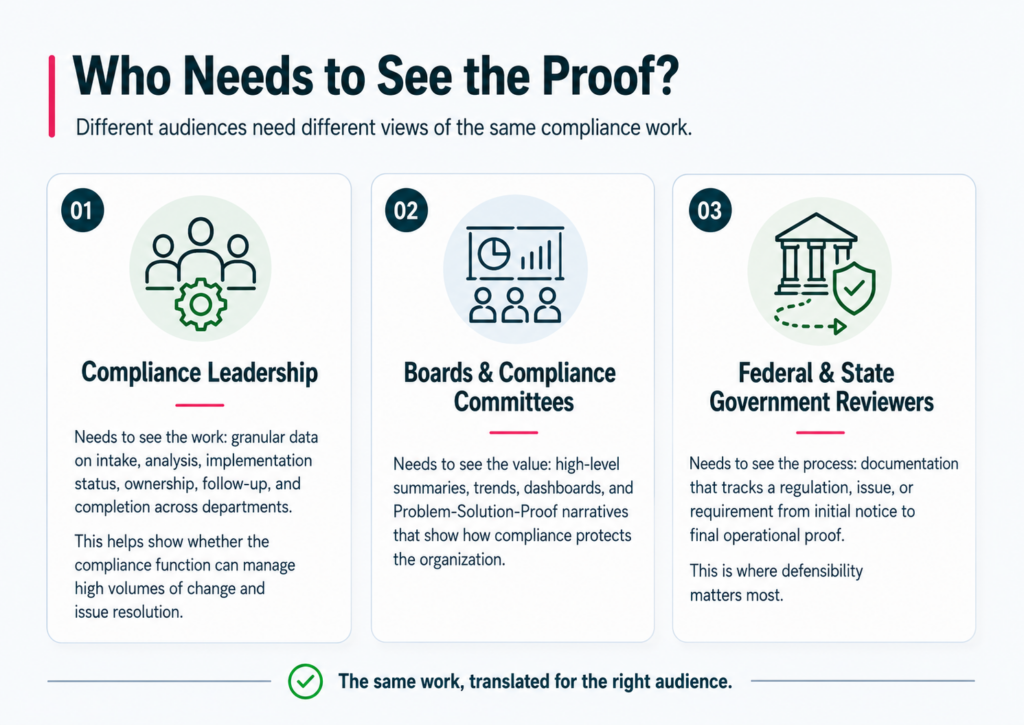
A strong system of record should support all three audiences without forcing the compliance team to rebuild the story each time. That is also why healthcare compliance reporting should do more than summarize activity. It should help teams monitor risk, track ownership, and show what has been reviewed, assigned, completed, and verified.
The problem with scattered documentation
Most healthcare compliance leaders already understand that documentation is important. The challenge is usually not awareness. It is execution.
Documentation gaps often happen because compliance work is reactive. Fire drills, urgent requests, audits, investigations, and unexpected issues interrupt routine logging. Teams may also struggle with unclear ownership. If nobody knows who is responsible for documenting the who, what, when, and outcome, records become inconsistent or incomplete.
Another common challenge is the optimism trap. Teams may underestimate how long education, monitoring, corrective action, and documentation will actually take. A timeline that looks reasonable in April may become unrealistic by June if staffing changes, operational demands, or competing priorities interfere.
Resource scarcity creates another barrier. When teams rely on spreadsheets, shared drives, emails, personal folders, or disconnected tracking systems, documentation becomes harder to maintain and harder to retrieve.
The result is a familiar pattern: compliance teams do the work, but the proof is scattered.
That same issue shows up in broader regulatory change management. As YouCompli has covered in From Manual to Scalable: How to Manage Healthcare Compliance Risk, the pace and complexity of healthcare regulatory change can become a risk of its own when teams do not have systems that help them manage it.
What a defensible system of record should include
A true system of record is more than a folder on a drive.
It should function as a single source of truth for compliance documentation. That means the organization can find the right records, verify who did what and when, understand which version of a requirement or policy was used, and show how the work connects to oversight expectations.
At minimum, a defensible system of record should support:
- Retrievability: Can the team find a specific record from three years ago in under ten minutes?
- Version control: Is everyone working from the current version of the requirement, policy, or process?
- Audit readiness: Can the team move from searching for proof to presenting proof?
- Workflow accountability: Is it clear who owned each step and when action was taken?
- Documentation integrity: Can the record show objective evidence, not just a subjective summary?
This is especially important when documentation needs to support regulatory obligations, board reporting, state audit readiness, False Claims Act concerns, privacy investigations, billing issues, or corrective action follow-through.
For teams thinking through the structure of their compliance program, YouCompli’s article on how the OIG’s General Compliance Program Guidance addresses the Seven Elements is a useful related read.
How to structure compliance documentation for defensibility
It is not just what the team documents. It is how the documentation is structured.
To stand up to external scrutiny, documentation should go beyond a simple “yes” or “no.” It should create a clear trail that another person can understand later, even if the original owner has moved roles or left the organization.
A few practical standards help.
Every record should include audit-ready details such as date, time, owner, approver, relevant metadata, and objective evidence. If a policy change connects to training, monitoring, or corrective action, those related records should be cross-referenced. The documentation should tell the whole story from issue identification to resolution.
Compliance teams should also avoid subjective conclusions that are not supported by facts. A strong record should focus on what was observed, what requirement or regulation was cited, what decision was made, what action was taken, and what evidence supports the outcome.
One useful test is the ten-minute rule: can a specific record be retrieved and explained in under ten minutes?
If not, the documentation may exist, but it may not be defensible in a practical sense.
For more on how audit readiness requires a proactive posture, see YouCompli’s article, With Compliance Audits, The Best Defense is a Good Offense.
The operational toolkit behind prove-it compliance
Once the system of record exists, compliance teams need the daily tools that keep it useful.
A few core logs and plans often create the backbone of defensible documentation:
Compliance work plan: Shows planned initiatives, resource allocation, and progress against organizational and departmental goals.
Audit and monitoring plans: Show systematic checking, proactive issue detection, and corrective action follow-through.
Education and training plan: Shows what training was provided, who attended, and what expectations were communicated to impacted workforce members.
Investigation and disclosure log: Shows how issues were identified, investigated, resolved, and disclosed to regulators when appropriate.
The key is to make documentation a natural byproduct of the workflow, not an extra task that happens weeks later from memory.
For example, an investigation log should be updated at each stage of an inquiry. Waiting until the end increases the risk that context, decisions, and details will be lost.
Moving from activity reporting to impact reporting
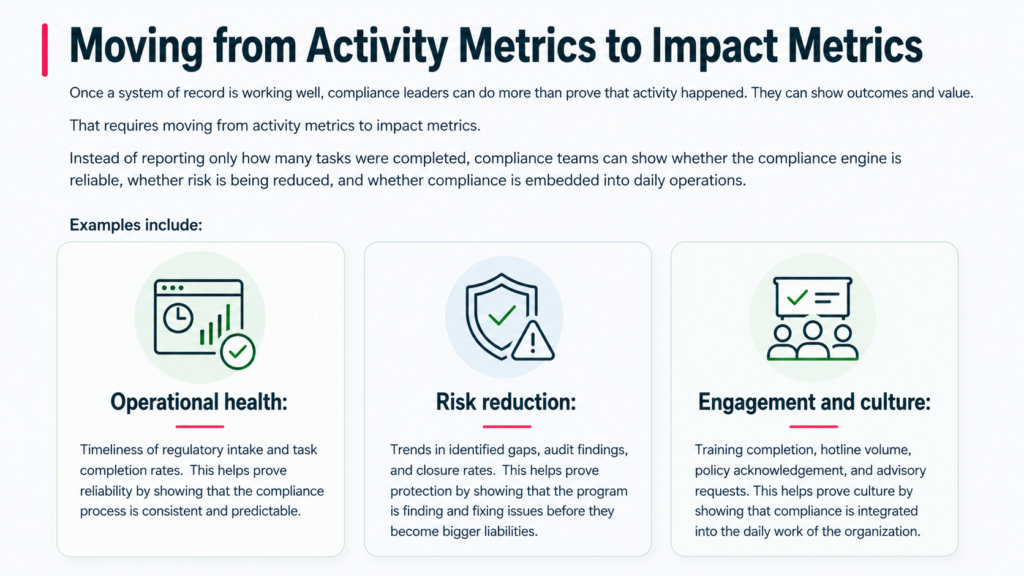
Once a system of record is working well, compliance leaders can do more than prove that activity happened. They can show outcomes and value.
That requires moving from activity metrics to impact metrics.
Instead of reporting only how many tasks were completed, compliance teams can show whether the compliance engine is reliable, whether risk is being reduced, and whether compliance is embedded into daily operations.
Examples include:
Operational health: Timeliness of regulatory intake and task completion rates. This helps prove reliability by showing that the compliance process is consistent and predictable.
Risk reduction: Trends in identified gaps, audit findings, and closure rates. This helps prove protection by showing that the program is finding and fixing issues before they become bigger liabilities.
Engagement and culture: Training completion, hotline volume, policy acknowledgement, and advisory requests. This helps prove culture by showing that compliance is integrated into the daily work of the organization.
This is also where the Problem-Solution-Proof model becomes useful.
For more on reporting compliance value, see Healthcare Compliance KPIs: Real-Time Data Dashboards and YouCompli’s Healthcare Compliance Reporting and Verification page.
Using the Problem-Solution-Proof framework
Board and senior leadership reporting should not be a long list of compliance activities. It should tell a clear story.
The Problem-Solution-Proof framework helps compliance leaders frame that story:
Problem: What specific regulatory challenge, operational risk, issue, or gap required action?
Solution: What did the organization do in response?
Proof: What objective evidence shows that the action was completed and had the intended effect?
For example:
Problem: New state-level False Claims Act requirements.
Solution: Implemented a new verification workflow and staff training.
Proof: 100% training completion and zero documentation gaps found in an internal audit.
This kind of reporting helps leadership see not just what compliance did, but what changed because of the work.
How mature documentation helps compliance evolve
A mature system of record does more than store documentation. It helps compliance leaders spot trends.
If one department consistently misses documentation deadlines, that is not just a tracking issue. It is a roadmap for targeted improvement. If a recurring policy issue keeps appearing, the problem may not be staff effort. It may be that the policy is confusing, difficult to apply, or not supported by enough training.
By documenting and reviewing these patterns, compliance teams can move from reactive oversight to proactive leadership.
That is the shift from documentation as storage to documentation as intelligence.
When technology becomes necessary
Manual habits are often the starting point for compliance documentation. But as regulatory change volume grows, manual systems can become difficult to maintain.
Spreadsheets, shared folders, inboxes, and disconnected tracking systems may work for a small number of issues. But they often create problems when teams need consistent workflows, objective evidence, assignment tracking, audit trails, reporting, and centralized retrieval.
When evaluating software to support regulatory change management documentation, compliance teams should look for capabilities that:
- Act as a centralized repository
- Automate audit trails
- Reduce time and resource burdens through workflow automation
- Show who did what and when
- Preserve documentation integrity
- Support defensibility for state audits, False Claims Act concerns, and federal oversight
- Function as more than a filing system
The goal is not simply to digitize documentation. The goal is to make the compliance program more accountable, searchable, reportable, and defensible.
For a deeper software evaluation framework, see What to Look for in Regulatory Change Management Software for Healthcare Compliance. You can also review How YouCompli Works to see how regulatory change can move through a repeatable process: know what changed, decide what matters, manage the work, and verify completion.
The prove-it moment
Effective documentation is more than a regulatory requirement. It is the bridge between compliance activity and organizational safety.
When documentation is scattered, compliance teams are forced to reconstruct the proof later. When documentation is structured, searchable, and tied to workflow, the organization is better prepared for board reporting, audits, investigations, and leadership conversations.
That preparation matters when the prove-it moment arrives.
The strongest compliance documentation does not just show that work happened. It shows that the organization took the issue seriously, assigned ownership, acted on the requirement, verified the outcome, and preserved the proof.
That is the difference between activity and defensibility.
Want to see how your documentation process holds up?
Take the Prove-It Compliance Readiness Check to evaluate whether your current process supports retrievability, accountability, defensibility, and leadership-ready reporting.
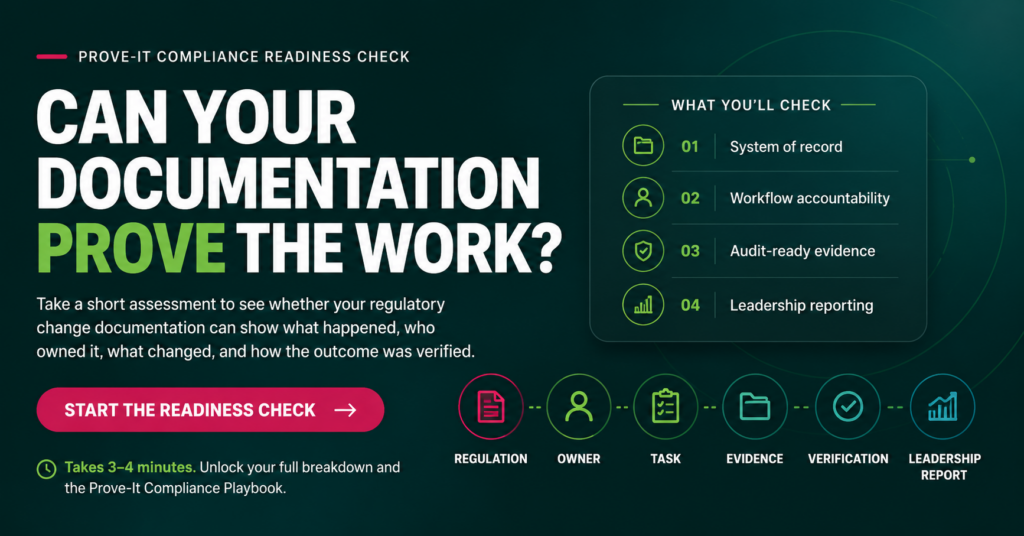
You can also download the full Prove-It Compliance Playbook for a more detailed framework on building a defensible system of record for healthcare compliance documentation.