

The HHS OIG recently released an audit report in which they concluded that for a recent one-year period, Medicare improperly paid physicians approximately $15.2 million for sacroiliac joint (SI) injections (see: https://oig.hhs.gov/reports/all/2026/medicare-improperly-paid-physicians-an-estimated-152-million-for-sacroiliac-joint-injections/).
SI injections can help some patients improve their spinal mobility as well as relieve pain. Medicare covers these injections under certain conditions but not others. That’s where confusion can create painful compliance risks.
Most Recent Audit in Series Related to Spinal Pain Management Services
This was the most recent audit in a series of audits related to spinal pain management services which the OIG has been performing over many recent years.
In prior audits of similar spinal services, the OIG found, for example, that Medicare improperly paid physicians for facet-joint interventions for more than 50 percent of sampled services that didn’t comply with one or more of the Medicare requirements:
- https://oig.hhs.gov/reports/all/2023/medicare-improperly-paid-physicians-an-estimated-30-million-for-spinal-facet-joint-interventions/
- https://oig.hhs.gov/documents/audit/9596/A-09-20-03003-Complete%20Report.pdf
- https://oig.hhs.gov/documents/audit/9602/A-09-20-03010-Complete%20Report.pdf
They also reported finding improper payments associated with epidural steroid injections:
Audits Continue in Therapeutic Spinal Pain
In addition, last year, they published audit findings that said Medicare could have saved an estimated $17.7 Million if CMS oversight had prevented at-risk payments for anesthesia administered during spinal pain management procedures:
Consequently, it should come as no surprise to healthcare compliance professionals that the audits in the therapeutic spinal pain space continue with the recent report about SI joint injections.
Background on Crucial SI Joints
The SI joints connect the lower portion of the spine to the pelvis.
They support upper-body weight and play an important role in walking and changes in posture or position, such as moving from standing to sitting. These joints become painful for various reasons, including sacroiliac joint dysfunction, which occurs when the joint moves too much or too little, often due to injury, pregnancy or osteoarthritis.
To improve movement and relieve lower back pain, a physician may administer an SI joint injection. A diagnostic injection is first used to determine whether the SI joint is the source of the pain. Significant immediate pain relief following the injection strongly suggests that the SI joint is responsible.
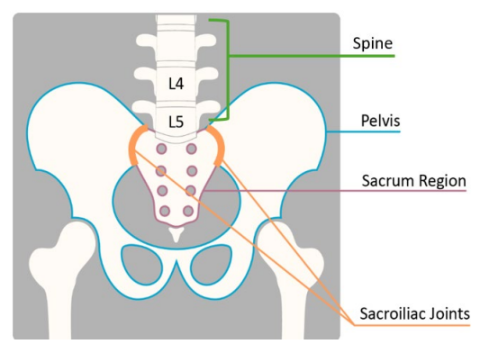
(Image from page 2 of the OIG report)
Once the SI joint is confirmed as the pain source, a therapeutic injection may be administered, with pain relief potentially lasting up to six months.
How SI Joint Injections Are Covered
Medicare Part B covers SI joint injections when medically reasonable and necessary. Five of seven Medicare Administrative Contractors (MACs) have local coverage determinations (LCDs) outlining requirements for
- Pain indications
- Imaging and pain assessment
- Coverage limits
- Diagnostic and therapeutic injections
These LCDs limit coverage to two diagnostic and four therapeutic injection sessions within a rolling 12-month period, whether performed unilaterally or bilaterally.
Billing and Coding for SI Joint Injection Procedures
Each MAC also issued billing and coding guidance stating that physicians must add the “KX” modifier to each claim line for diagnostic injections to distinguish them from therapeutic injections. (Appendix C of the OIG Audit report summarizes the MACs, the states they cover, and the specific LCD number and LCD Reference article pertinent to their audit.)
CPT code 27096 is used for injections made directly into the sacroiliac joint, while CPT code 64451 is used for injections targeting the nerves that innervate the sacroiliac joint.
OIG Selects 100 Random Samples out of 186,000+ Procedural Sessions
For the audit report, the OIG selected a random sample of 100 SI joint procedural sessions from a population of 186,842 sessions paid for by five MACs in a one-year period. They requested physicians’ supporting documentation to determine if the claims met Medicare requirements including LCD and LCD Reference Articles.
Of the 100 sampled sessions, 28 complied with Medicare requirements, and 75 complied with Medicare billing guidance. However, the remaining 72 sessions didn’t comply with Medicare requirements, and 25 didn’t comply with Medicare billing guidance.
Seventy-two sampled sessions didn’t comply with one or more of the requirements. The OIG report summarizes the noncompliant sessions by the type of noncompliance observed:
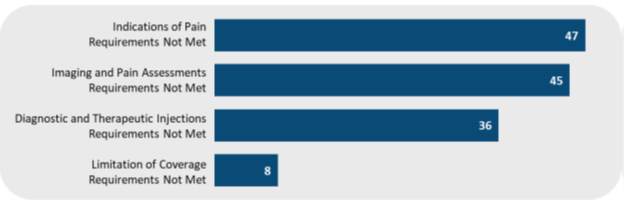
(The total exceeds 72 sessions because 41 sessions had more than one deficiency.)
Estimated Improper Payments of $15.2 Million in Sample Universe
OIG then extrapolated their findings across the entire population of 186,842 sessions and calculated overpayments to determine their estimated improper payment amount of $15.2 million for the universe of sessions sampled for the one-year period.
OIG found that although CMS had systems to identify some billing errors, it didn’t provide enough additional oversight or education to help physicians understand and follow Medicare requirements. CMS relied on MACs to educate physicians, but this wasn’t sufficient.
As a result, some physicians may not have fully understood the requirements and billing rules. Physicians with billing errors said that more frequent and consistent training would have helped them understand the rules and avoid future errors.
Other Improper Payments Assumed, Potentially Pushing Total Higher
As mentioned, the sample universe of SI joint procedural sessions was limited to the five of the seven MACs that had issued LCDs. The other two MACs that didn’t have LCDs paid physicians $12.3 million for sacroiliac joint injection sessions. That accounts for approximately 36 percent of total Medicare payments for sacroiliac joint injections nationwide.
Since these sessions were excluded from the audit, OIG wrote that this set of payments to physicians may also include improper payments. If true, the estimated $15.2 million in improper payments could potentially be higher.
Four Areas of Noncompliance in SI Joint Injection Procedures
Below are four categories of noncompliance and indications of unmet requirements:
1 – Indications of Pain Requirements Not Met
- At least three positive findings with provocative maneuvers
- Low back pain below the L5 vertebra without radiculopathy
- Low back pain that persists despite a minimum of four weeks of conservative therapies
- Clinical findings and imaging studies that do not suggest any other diagnosed or obvious cause of the lumbosacral pain such as tumor and fracture
- Low back pain for at least three months
- Moderate to severe low back pain primarily experienced over the anatomical location of the sacroiliac joints between the upper level of the iliac crests and the gluteal fold
2 – Imaging and Pain Assessments Requirements Not Met
- The sacroiliac joint primary pain level must be measured prior to the injection at the beginning of the session.
- The post procedure pain level must be measured at the end of the session.
- The injections must be performed under computed tomography (CT) or fluoroscopy image guidance with contrast unless the patient has a documented contrast allergy so that ultrasound guidance without contrast may be considered.
3 – Diagnostic or Therapeutic Sacroiliac Joint Injections Requirements Not Met
- A diagnostic injection must have provided a minimum of 75 percent relief of primary pain before a therapeutic injection is administered
- A subsequent therapeutic injection is not reasonable and necessary when the prior therapeutic injection did not result in at least 50 percent consistent pain relief or functional improvement for at least three months
4 – Limitation of Coverage Requirements Not Met
- Administer other musculoskeletal injections in the lumbosacral spine during the same session as sacroiliac joint injections
- Perform multiple injections (e.g., epidural steroid injections, facet-joint injections, and trigger point injections) during the same session as sacroiliac joint injections and during the period when the physician is evaluating whether the injection reduced pain (i.e., efficacy assessment period)
The Audit Details Smart Compliance Professionals Look For
Like most medical claims’ audits, the “devil is in the details”. To avoid problems, wise compliance professionals will:
- Monitor the most recent LCDs from their MAC
- Maintain a process to review the LCDs and implement processes to ensure compliance
- Perform records audits for both coding and medical necessity
Some coders might have the requisite medical knowledge to audit for medical necessity. However, it usually requires a clinical background as well as an understanding of Medicare billing requirements such as LCDs.
The regulatory compliance landscape around SI joint injections is dynamic and significant. It’s worth paying attention to those devilish details.
CJ Wolf, MD, M.Ed. is a healthcare compliance professional with over 22 years of experience in healthcare economics, revenue cycle, coding, billing, and healthcare compliance. He has worked for Intermountain Healthcare, the University of Texas MD Anderson Cancer Center, the University of Texas System, an international medical device company and a healthcare compliance software start up. Currently, Dr. Wolf teaches and provides private healthcare compliance and coding consulting services as well as training.

Here are other resources to check out next:
How to Avoid False Claims Related to Medical Necessity
This expert blog gives compliance readers actionable steps to avoid civil monetary penalties and False Claims Act scrutiny resulting from documented medical necessity failures.
Physician Coding and Billing Errors Enforcement: Compliance
Get more context on enforcement actions stemming from unbundling, modifier misuse, and improper billing during same-day procedures.
Know the Compliance Risk for Certain Anesthesia Services
Learn about another recent OIG audit targeting spinal injection procedures and associated anesthesia/sedation coverage limitations.
Medical Necessity: A Guide for Healthcare Compliance Leaders
The linked article specifically discusses how MAC LCDs define medical necessity (such as requiring four weeks of conservative therapy prior to approving spinal injections)