

Durable Medical Equipment (DME) billing remains a significant target of the government with regard to compliance risks. The insights and strategies in this blog offer guidance to help health systems avoid exposure and losses from DME fraud.
At a Glance: DME Fraud Risks
- Recent enforcement: CMS announced action involving 11 DME suppliers and $3.4 billion in suspected fraudulent billing.
- Three vulnerabilities: OIG identifies supplier enrollment, physician orders, and Medicare enrollee identification numbers as key elements in DME fraud schemes.
- For health systems: Review relevant supplier relationships, ordering practices, clinical documentation, and processes for identifying suspicious activity.
Recently, CMS announced that 11 DME companies have been barred from receiving future Medicare Advantage (MA) Part C and D payments. The CMS decision is based on suspected fraudulent billing to the tune of $3.4 billion.
The suspicious activity was based on the following where the company:
- Submitted no claims prior to 2025
- Used improper billing practices for their claims
- Billed for medical equipment to patients who were already deceased
- Supplied equipment to patients who either never requested it or received it
The companies are known as DMEPOS suppliers: durable medical equipment, prosthetics, orthotics and supplies.
These 11 organizations and the resulting issues aren’t the only examples of DME dollars at risk of fraud, waste and abuse.
Health Systems Not Immune to Exposure from DME Risks
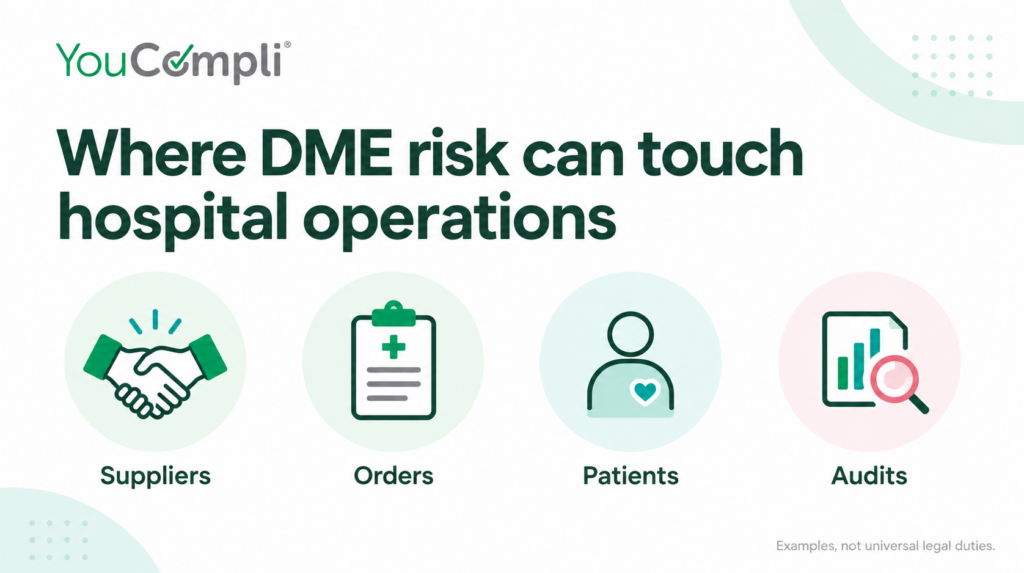
While DME fraud often originates with third-party suppliers, health systems are subject to direct operational and financial exposure. Compliance leaders who actively combat these schemes protect organizational revenue, preserve physician credentials, and prevent costly administrative disruptions.
Proactive fraud mitigation ensures seamless patient care while shielding health systems from aggressive federal audit scrutiny. It involves many goals that are already within the compliance mission:
- Protecting physician credentials and NPI integrity
- Fulfilling strict recordkeeping and order requirements
- Safeguarding patient care and trust
- Reducing downstream audit burden
- Ensuring Medicare Advantage network integrity
For example, fraudulent suppliers routinely harvest physician National Provider Identifiers (NPI) to generate fake orders for items like catheters, orthotics and glucose monitors. Proactive oversight prevents unauthorized order generation using health system provider credentials and protects clinicians from CMS sanction lists.
Other Areas of Government Focus: Catheter Audit Example
In addition to wide sweeping announcements like the one above about the 11 DME companies, other government agencies are focusing on specific types of supplies that might be vulnerable to fraud, waste and abuse.
For example, the U.S. Department of Health and Human Services Office of Inspector General (HHS-OIG) published the results of an audit they performed related to Medicare payments for intermittent urinary catheters.
Intermittent urinary catheters are covered under the Medicare Part B benefit for prosthetic devices for people who have permanent impairment of urination (i.e., permanent urinary incontinence), involuntary loss of urine, or permanent urinary retention (inability to voluntarily empty the bladder or pass urine). A treating practitioner orders catheters for an enrollee, and a supplier fulfills the order.
OIG Audit Finds $35+ Million in Improper Catheter Payments
OIG audited a period during which Medicare paid $303 million for these types of catheters. Based on the error rate in the sample used for the audit, OIG estimated that Medicare improperly paid $35.1 million for the catheters.
They cited examples where medical records didn’t support enrollees’ eligibility for curved-tip catheters or sterile catheter kits. For other claims in their sample, suppliers didn’t meet Medicare requirements for catheter refills, proof of delivery, or a standard written order.
Stopping Medical Device Scams at the Patient Level
Beyond this auditing work, OIG also issued a Consumer Fraud Alert for Urinary Catheter Scams. The fraud alert informs patients that scammers are targeting Medicare enrollees through phone calls, internet ads, and text messages with offers of free services, medical equipment, or gift cards after confirming their personal information and eligibility for specific Medicare services.
Often, the enticement for the individual is that they are “qualified” for items “at no cost” or “free.” Once the scammers obtain the enrollee’s personal information, monthly billing to Medicare will begin for medically unnecessary urinary catheters that may or may not actually be sent to the enrollee.
Three Areas to Monitor to Avoid DMEPOS Fraud
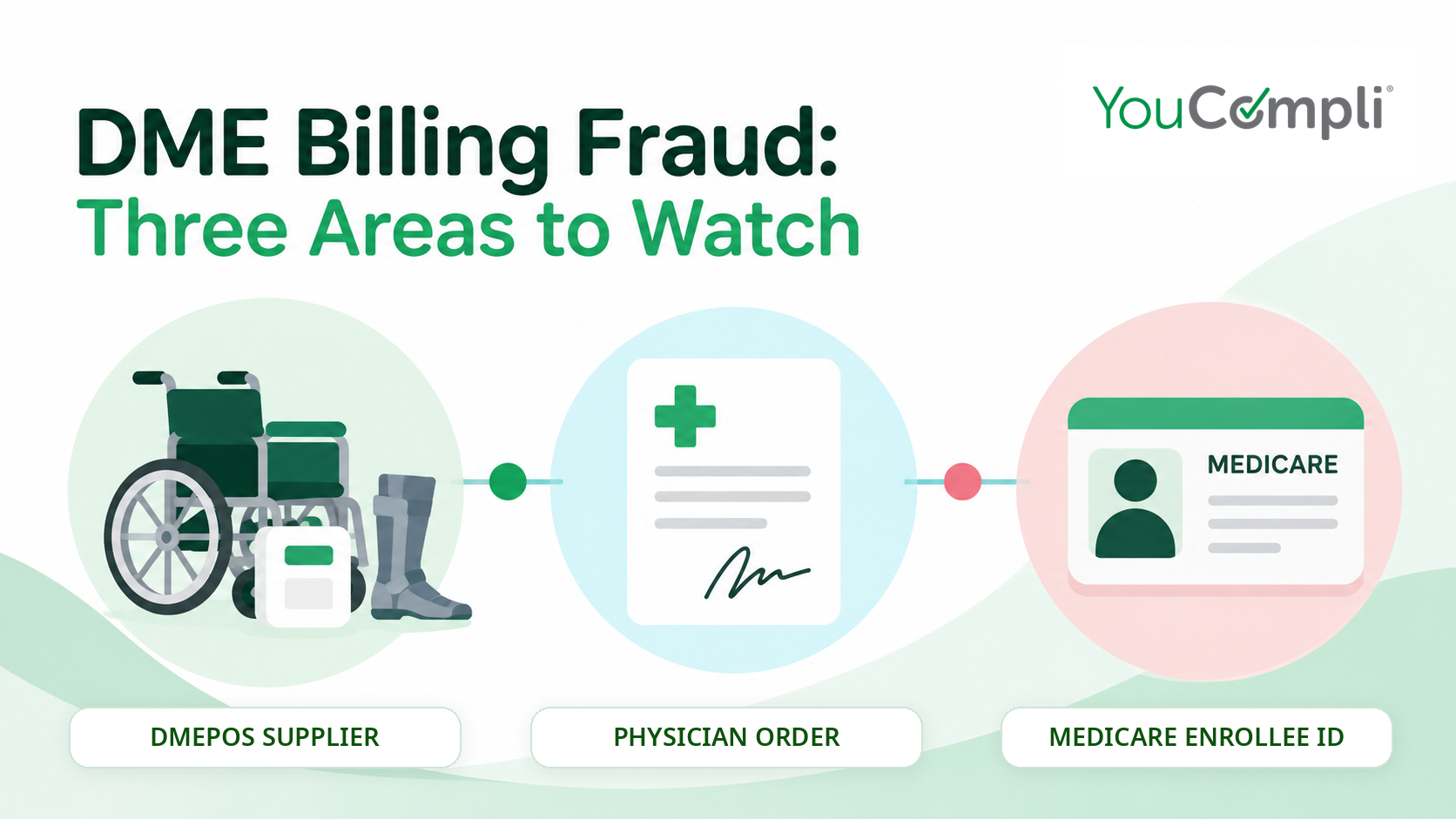
OIG has demonstrated their commitment to addressing fraud, waste and abuse challenges in the DME sector. In this white paper, “The Nation’s Challenge to Combat Durable Medical Equipment Fraud in Medicare,” OIG presents actions that CMS and others can take to stop bad actors from exploiting Medicare.
It focuses on three key elements that bad actors need to commit DMEPOS fraud:
1. Medicare-enrolled DMEPOS supplier
2. Physician order for DMEPOS product
3. Medicare enrollee’s identification number
1. How to Combat Medicare-enrolled DMEPOS Supplier Fraud
Maintaining strict referral standards prevents regulatory non-compliance and protects payer contract relationships. Health systems and affiliated provider networks must screen against the CMS Preclusion List and verify supplier enrollment.
Actions that OIG suggests CMS should take:
- Strengthen on-site inspections to prevent bad actors from enrolling in Medicare.
This could include additional unannounced on-site inspections to ensure bad actors can’t predict when site visits will occur.
- Improve detection of unreported changes of ownership and straw owners. This might include using AI or other technologies on an ongoing basis to identify changes in ownership that have not been reported to CMS.
- Ban suppliers from using paper applications to circumvent oversight.
- Increase oversight of newly enrolled DMEPOS suppliers. This could include CMS implementing a period of enhanced oversight of newly enrolled DMEPOS suppliers and those that recently changed ownership.
- Reassess and potentially update surety bond requirements to better deter fraud.
- Require all DMEPOS suppliers that bill Medicare Advantage to enroll in Medicare.
2. How to Combat Fraud in Physician Orders for DMEPOS
When CMS or OIG audits target improper supplier claims, health systems must produce matching clinical documentation to avoid administrative claw backs and penalties. Federal regulations require ordering physicians to maintain clinical records supporting medical necessity for seven years.
Actions that OIG suggests CMS should take:
- Engage ordering physicians in fraud-fighting efforts. CMS could develop an electronic verification method for physicians to confirm orders before certain claims are paid. Or CMS could issue reports to physicians detailing the DMEPOS they ordered and request that physicians review the information and report any fraudulent billing.
- Harness new technologies and analytic tools to better detect and stop payments for fraudulent DMEPOS claims. OIG recommends that CMS explore the potential for using AI in this area.
- Enhance the use of payment suspensions.
- Expand medical reviews to prevent fraud.
- Work with secondary payers to stop fraudulent billing. CMS recently began sharing payment suspension information with secondary payers to help them prevent payments to potentially fraudulent suppliers.
- Require Medicare Advantage organizations to submit the identification number for physicians who order DMEPOS.
3. How to Combat Fraud in Medicare Enrollee ID Numbers
Schemes that target patients with unsolicited, unnecessary or low-quality equipment disrupt care plans and harm patient trust. Robust compliance workflows ensure discharge planners and care coordinators connect patients exclusively with legitimate, Medicare-enrolled suppliers.
Actions that OIG suggests CMS should take:
- Discontinue or better protect enrollee lookup tools.
- Prohibit DMEPOS suppliers from all types of unsolicited contact with enrollees.
- Partner with social media companies to prevent sale of enrollee identification numbers on their platforms.
- Engage Medicare enrollees in the fight against fraud.
Needless to say, DME is an area fraught with fraud, waste and abuse risk, and government enforcement agencies are focusing more on DME, not less. If your organization participates in this space, make sure your compliance program is preparing against the various DME compliance risks we’ve talked about here and others as they arise.
Download Free Checklist
About the author
CJ Wolf, MD, M.Ed. is a healthcare compliance professional with over 22 years of experience in healthcare economics, revenue cycle, coding, billing, and healthcare compliance. He has worked for Intermountain Healthcare, the University of Texas MD Anderson Cancer Center, the University of Texas System, an international medical device company and a healthcare compliance software start up. Currently, Dr. Wolf teaches and provides private healthcare compliance and coding consulting services as well as training.

Video resource hub
Download our Latest Whitepaper

Sign-up for our Weekly Newsletter
Schedule a quick overview