
Help your healthcare organization mitigate risk by building strong relationships
When it comes to regulatory change management, healthcare organizations deal with a lot of complexity and confusion. As a compliance officer, you can help your organization cut through the chaos – and mitigate risk.
You can best support your organization by implementing effective regulatory change management practices. Yet many compliance officers overlook the key to establishing a strong regulatory change management program: building relationships with departmental and operational leaders.
Relationships are at the heart of regulatory change management programs. To be a successful influencer in your organization, hone these four skills:
- Know the who
- Be at the right tables
- Measure what matters
- Know the business
Know the who
Being an effective influencer requires a solid knowledge base about your organization and the ability to develop relationships. But influence skills don’t come naturally to everyone.
Don’t be intimidated if you’re uncomfortable with skills that may seem more suited for a sales role. Like any core competency, you can strengthen your influencer skills over time.
It starts with knowing who the key influencers and decision makers are in your organization. You need to understand who is responsible for making decisions, who leads implementation, and who will champion the change for the long haul.
Attorney Ken Zeko likens it to having a regulatory rolodex. He notes it’s important to identify – ahead of time – the department leaders and operational stakeholders in highly regulated areas and build relationships with them.
Healthcare organizations’ highly regulated areas include Revenue Cycle, Quality, Lab and Pharmacy, Legal, HIM, and Compliance. And they’re critical departments to focus on for relationship building. Fostering relationships in these areas will help ensure that you’re in the loop when decisions are being made.
Be at the right tables
Getting ahead of organizational risk also requires being at the right table when strategic decisions are being made. That’s why Shawn DeGroot, president of Compliance Vitals, advises: “Relationship building should be a daily occurrence for CCOs.”
“You can’t be a strategic advisor if you’re not at the strategy table,” adds Zeko. “Being prepared when a regulatory change comes in starts with compliance officers being visible across the organization. If compliance folks aren’t embedded enough with operational folks, they’re not aware to what extent they’re marshaling or assessing risks related to new regulatory changes.”
Attorney Ken Zeko
Zeko says it’s helpful to hold monthly operational compliance committee meetings: “It’s a working committee to look into compliance issues so that the compliance officer isn’t the only one doing the heavy lifting.”
Of course, relationships vary by department: the degree of regulatory change a department experiences affects its engagement with Compliance. As you form relationships across the organization, you can help leaders determine the most effective approach for mitigating risk in their respective area.
Measure what matters
Whether you’re talking with Pharmacy or Revenue Cycle colleagues, they want to know that you understand what matters to them. To demonstrate an understanding of operational leaders’ respective concerns, you should present metrics and business cases in a way that resonates with their motivators.
“Know your audience in order to understand their definition of effectiveness,” advises Charles Mazer, director of Corporate Compliance at NewYork-Presbyterian. “Understanding who you’re speaking to is important because the relationship defines everything. If I’m speaking to an operations person, they don’t care how many reviews I’m doing. But the board cares. If I’m speaking to the board, the more reviews the better.”
Charles Mazer, director of Corporate Compliance at NewYork-Presbyterian
The metrics you choose to evaluate your regulatory change management program will vary, depending on your audience. For a starting point on metrics to measure how well you’re managing regulatory change, consider the seven elements for compliance program effectiveness.
Healthcare compliance officers often rely on the seven elements as key performance indicators (KPIs) to measure whether their organization’s compliance goals are achieved. Element-based KPIs are a useful gauge of whether compliance activities are achieving results.
For example, a common organization-wide goal is requiring 100% of new employees to complete a Code of Conduct acknowledgment. Attorney Ken Zeko recommends another set of measurements: culturally impactful metrics.
Examples of culturally impactful metrics include the number of Compliance roadshow sessions completed or meetings between the compliance officer and board members. As you customize metrics to your audiences’ specific needs, keep in mind how your recommendations will affect other areas of the business.
Know the business
Serving as strategic business partner to the larger organization involves knowing the business of the organization and how it generates revenue. NewYork-Presbyterian’s Charles Mazer explains how his team builds business acumen.
“Our Compliance team is asked to complete a Revenue Cycle Academy,” Mazer says. “We need to be able to understand the business to work effectively in the space. Compliance is always tasked with explaining the benefit of acting compliantly to a business unit. It might not be revenue generating, but it’s risk mitigating. It’s what to do because it’s in your best interest.”
Knowing the business involves making sure your recommendations are practical for other teams to implement. And identifying compliance champions is a way to make sure you don’t have to do all the heavy lifting. This is critical because your work doesn’t end when a new policy or procedure is adopted.
“Artful communication is crucial, especially when you’re influencing other departments,” says Compliance Vitals President Shawn DeGroot. “Whenever something impacts the organization – and has a dramatic outcome that either reduced risk or improved business outcomes – identify compliance champions to hold up the people who reported the issues. If a physician is a compliance champion and advocate, it resounds throughout the organization! This approach not only builds relationships, it ensures that more than just the CCO is acting as the face of compliance and change management.”
Compliance Vitals President Shawn DeGroot
Empower Compliance Officers to Drive Better Health and Business Outcomes
Developing influencer skills – and combining them with established processes for managing regulatory change – will best position you to drive better health and business outcomes for your organization. I recently moderated a panel at the HCCA’s Annual Compliance Institute addressing this topic with Shawn DeGroot, Charles Mazer and Ken Zeko.
Our discussion generated useful tips on how compliance officers can establish standard processes and develop influencer skills to help their healthcare organizations mitigate risk. We also explored industry research on compliance professionals’ best practices for lessening organizational risk through regulatory change management.
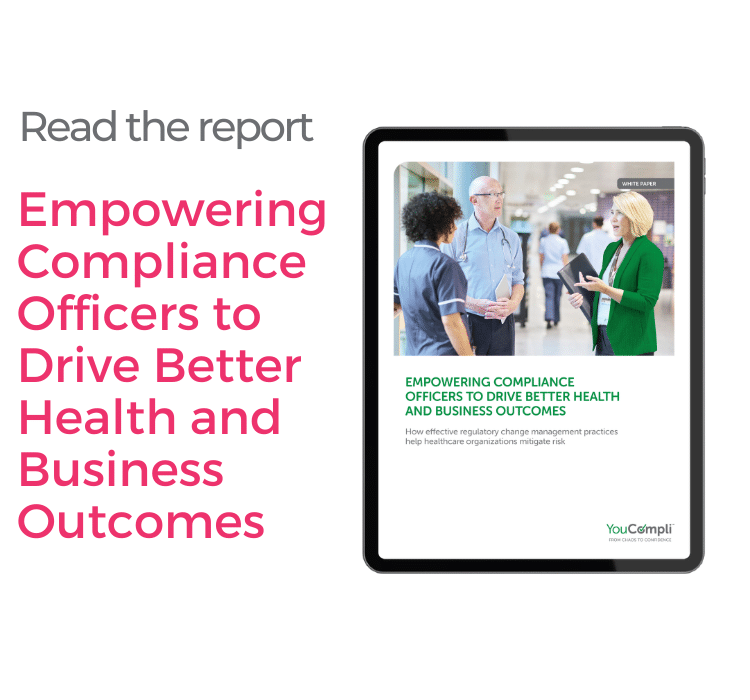
Key takeaways are in the white paper Empowering Compliance Officers to Drive Better Health and Business Outcomes. Download the report for insights on how to lessen risk and deliver value to your organization through strong regulatory change management.
Never miss an article, register now to receive emails from YouCompli!
Jerry Shafran
Jerry Shafran is the founder and CEO of YouCompli. He is a serial entrepreneur who builds on a solid foundation of information technology and network solutions. Jerry has founded, managed, and sold software and content solutions that simplify complex work. His innovations enable professionals to focus on their core business priorities.