

For healthcare compliance leaders, financial literacy is not optional. Compliance risk often hides in the fine print of financial data, making literacy a prerequisite for effective oversight.
To identify anomalies or potential regulatory “red flags,” compliance officers must move beyond a high-level view of healthcare finance and understand how clinical operations translate into financial entries.
What does a compliance leader need to understand? Things like:
- Budgeting and capital planning
- Internal controls and risk
- Grant and research compliance
- Key performance indicators (KPIs)
- Communication between CFO and compliance officer
Familiarity with the 14 steps of the revenue cycle is also valuable for mitigating risks associated with reimbursements and 340B compliance. (This topic is covered later in the blog.)
Where Do Healthcare Compliance and Finance Intersect?
Regulatory compliance and healthcare finance overlap in multiple ways. Compliance-related areas with a financial angle include:
- Medicare, Medicaid reimbursement
- 340B drug pricing
- Stark Law and anti-kickback statutes
- Charity care
- Financial assistance requirements
What Should Compliance Leaders Understand About Financial Statements?
To build fiscal literacy, let’s start with some foundational concepts – financial statements. Compliance officers should have a basic understanding of these types of statements:
- Balance Sheet
- Income Statement
- Cash Flow Statement
1. The Balance Sheet: Assessing Financial Integrity Through a “Snapshot”
The balance sheet provides a snapshot of an organization’s financial health at a specific point in time, detailing its assets, liabilities and equity.
Why Compliance Should Care: Monitoring the balance sheet helps ensure that assets are properly recorded, and that liabilities like these are appropriately disclosed:
- Potential legal settlements
- Debt obligations
- Medicare overpayments
2. The Income Statement: Monitoring Operational Risk Over Time
Unlike the balance sheet snapshot, the income statement tracks revenue and expenses over a specific period, such as a month or a fiscal year. The income statement puts a focus on total revenue and expenses, and the difference between them, while distinguishing between operating and non-operating items. Those two concepts are compared in the chart below.
| Operating Items | Non-Operating Items | |
| Definition | Costs or revenues essential for daily business activities. | Costs or revenues not directly tied to primary business functions. |
| Purpose | Maintain day-to-day operations and drive main revenue streams | Handle secondary activities, financing, or irregular events. |
| Frequency | Highly recurring and regular | Often irregular, one-time, or incidental (e.g., interest). |
| Examples | Employee wages, rent, utilities, marketing | Interest expense, investment gains/losses, and legal settlements. |
In an income statement, it’s important to distinguish between accrual-basis accounting (matching revenue to period it was earned) and cash-basis accounting (recording transactions only when money changes hands).
Why Compliance Should Care: By comparing current monthly performance against previous years, compliance officers can spot outliers in revenue or sudden spikes in expenses that could indicate billing errors, “upcoding,” or improper financial arrangements under the Stark Law.
3. The Cash Flow Statement: Ensuring Operational Sustainability
The cash flow statement tracks the actual movement of cash into and out of the organization, categorized by:
- Operating activities
- Investing activities
- Financing activities
Why Compliance Should Care: Understanding cash flow is vital for making sure the organization has liquidity to maintain compliance standards even during times of financial strain. A significant discrepancy between reported net income and actual cash flow can signal deep-seated issues with revenue cycle integrity.

Revenue Cycle as Regulatory Roadmap
For a prepared healthcare compliance leader, the revenue cycle isn’t just a financial process; it’s a regulatory roadmap. From initial patient interaction to final collection, each step presents a unique set of compliance risks that can lead to audits, fines or loss of reimbursement if not managed with understanding.
What Compliance “Trapdoors” to Watch for in the Revenue Cycle
The revenue cycle is full of complexity, largely fueled by the impact of different hospital types (PPS, critical access, disproportionate share, and tribal hospitals) on Medicare and Medicaid rates.
While the full revenue cycle has 14 distinct stages, compliance officers should pay particular attention to these “trapdoors” where financial operations must meet strict federal regulations:
- Front-End Integrity (Scheduling and Registration): Accuracy is paramount to ensure Medicare and Medicaid reimbursements aren’t jeopardized by incorrect patient data or lack of prior authorization.
- Clinical Documentation and Coding: This is a high-density risk area. Compliance must make sure that coding reflects the actual services provided to avoid allegations of “upcoding” or “unbundling,” which can trigger False Claims Act investigations.
- 340B Drug Pricing Program: If an organization participates in 340B, the revenue cycle needs rigorous internal audits to establish compliance with drug diversion and duplicate discount prohibitions. The stakes will be even higher if the program undergoes potential changes regarding payment models.
- Billing and Claims Submission: Errors in this stage directly impact the Clean Claim Rate. More importantly, consistent billing errors for federal healthcare programs can lead to significant liability under Anti-Kickback Statutes or the Stark Law if improper financial relationships are found.
Monitoring Denial Management at Back End of Revenue Cycle
A robust compliance program monitors the back end of the revenue cycle as closely as the front. Analyzing denials can reveal systemic issues in documentation or billing practices that, if left unaddressed, represent both financial loss and compliance vulnerability.
What KPIs Should Compliance Watch as Part of Financial Oversight?
For a healthcare compliance officer, financial data is more than just a reporting requirement. It’s a proactive tool for risk assessment. By monitoring specific KPIs, compliance teams can move from reactive auditing to strategic oversight and identify operational stressors before they escalate into violations.
The “Big Four” Financial KPIs for Compliance Officers
Comprehensive financial oversight should track these four metrics:
- Operating Margin: This measures whether the organization’s core clinical mission is profitable after all operating and overhead costs are paid. A shrinking margin often leads to “cutting corners” in staffing or documentation, which directly increases compliance risk.
- Days Cash on Hand: This indicates liquidity. How many days can an organization operate using its current cash reserves if all revenue stopped? Higher liquidity provides the financial “breathing room” to maintain compliance and quality standards even during economic downturns.
- Clean Claim Rate (CCR): A high CCR (ideally 95% or higher) indicates that claims are being submitted without errors the first time. A low rate is a red flag for systemic billing or documentation errors that could trigger federal audits under the False Claims Act.
- Payer Mix: It’s critical to understand the percentage of revenue coming from Medicare, Medicaid and private insurance. In many healthcare models, Medicare functions as a “break-even” payer, while Medicaid reimbursements often fall below the actual cost of care, placing additional pressure on revenue integrity.
What to Know about Budgeting and Internal Controls
Compliance officers should also distinguish between the Operating Budget (daily/annual clinical operations) and the Capital Budget (typically reserved for long-term investments or items over $10,000).
To prevent fraud and ensure financial integrity, a compliance program must enforce strict segregation of duties. This assures that no single individual has control over all aspects of a financial transaction, serving as a primary defense against embezzlement and improper financial reporting.

Using the SBAR Tool to Structure CFO and Compliance Communication
The most effective healthcare compliance programs are those where the Chief Compliance Officer (CCO) and Chief Financial Officer (CFO) operate as strategic partners.
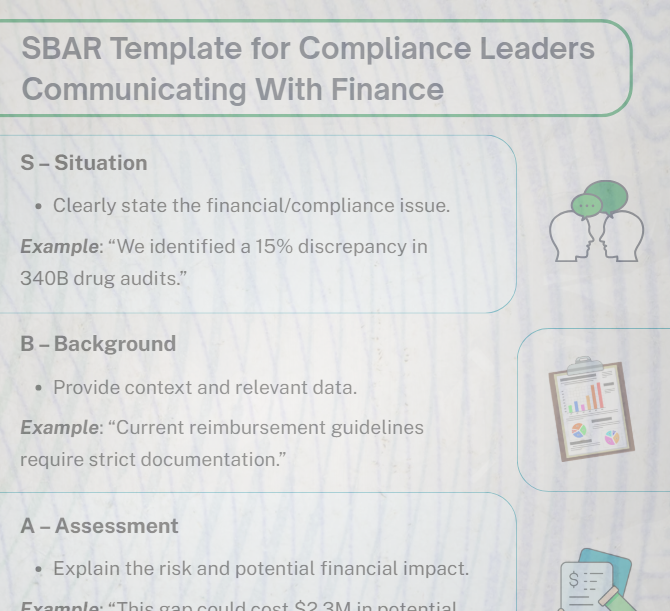
However, communicating complex compliance risks in a way that aligns with financial priorities requires a structured approach. This is where the SBAR tool (Situation, Background, Assessment, Recommendation) becomes invaluable for justifying financial decisions and resource allocation. (Download a helpful SBAR template at the end of this article)
Four-Step Method for Financial Advocacy
Use this four-step method to present compliance needs to your finance team:
- Situation: Clearly state the immediate financial or regulatory issue.
Example: “We have identified a 15% discrepancy in our 340B drug pricing audits.”
- Background: Provide the necessary context and data.
Example: Current Medicare reimbursement rates for these drugs are subject to strict transparency requirements.
- Assessment: Offer your professional analysis of the risk.
Example: Failure to rectify this documentation gap poses a significant risk to operating margin and regulatory standing and could trigger a federal audit.
- Recommendation: Propose a specific, data-backed solution.
Example: “I recommend an immediate investment in automated tracking software as part of the next capital budget cycle.”
How Compliance Can Secure a “Seat at the Table”
By confidently speaking the language of finance with terms like liquidity, capital planning and debt financing, compliance officers move beyond being seen as a “cost center” and the “Department of No.”
Instead, compliance can become a guardian of the organization’s financial sustainability, ensuring that compliance is integrated into every high-level discussion, from annual budgeting to long-term strategic growth.
Ready to drive more compliance value? Reach out to see how YouCompli can help.
Download our Latest Whitepaper

Sign-up for our Weekly Newsletter
Qualified compliance professionals do the heavy lifting for you, simplifying regulatory change management