
Compliance risks associated with medical necessity happen when providers fail to show clinical evidence that a service is essential for a patient’s health. This often leads to legal, financial and operational consequences.
Continue reading
Compliance risks associated with medical necessity happen when providers fail to show clinical evidence that a service is essential for a patient’s health. This often leads to legal, financial and operational consequences.
Continue reading
In this article, Lisa Estrada shares her perspectives on why systems beat heroes in compliance and how AI can help accelerate systems thinking in fast-paced healthcare environments.
Continue reading
Artificial intelligence is beginning to reshape the compliance landscape, but the field is still in the early stages of adoption. Compared with other business functions, compliance has been slower to embrace AI, especially in healthcare, where concerns about risk, regulation, and potential bleed-over into clinical decision-making have made organizations particularly cautious.
Yet the opportunity is substantial, especially when it comes to systems thinking.
Effective compliance programs depend on systems thinking. Rather than viewing each request for guidance, investigation, or remediation as an isolated issue, savvy compliance teams look at how individual problems fit into larger patterns.
One of the challenges in any business function is the tension between individual heroics and well-designed systems, and, ultimately, systems win every time. Many compliance officers have been conditioned to act like lifeguards, diving in to save departments from themselves. But this reactive approach consumes time and limits impact. You stay busy, but the organization doesn’t necessarily become more compliant.

Shifting away from heroic interventions requires time, strategic thinking and structural planning, resources that compliance professionals rarely have in abundance. This is where AI becomes a powerful ally.
The key to building proactive compliance is carving out the mental space to think more broadly about operational processes. AI doesn’t replace human expertise, but it can significantly accelerate the work.
AI tools can analyze the countless issues compliance teams handle daily and help generate system-level recommendations. Think of AI as a partner that gets you to the 50- or 60-yard line, far enough to give you a strong foundation, but still requiring human judgment to complete the plan.
The first step is identifying patterns:
Once you see the trends, you can begin imagining the systems that will address them. AI excels at helping structure these ideas.
A practical way to start is by giving your AI assistant raw input:
Then you can prompt the AI with something like:
“I want to build a system to help identify and minimize these risks within a complicated environment. What elements should be included, and what considerations fall under each element?”
The output becomes a foundation, a map of decision points and organizational steps you can refine.
Compliance work is complex, and many officers get stuck not because they lack insight but because they lack time. AI helps break the gridlock by organizing information, highlighting key considerations, and suggesting frameworks.
The AI provides structure; the compliance professional brings subject-matter expertise. In this collaborative process, the AI’s suggestions spark additional ideas and help you think more holistically. The result is a level of systems thinking that becomes far more accessible even in hectic environments.
Despite its power, AI cannot replace an experienced compliance officer. It draws from online information and from what you feed it, but it cannot grasp organizational nuance, personalities, or culture.
For example, an AI may outline a solid system, but only the compliance officer understands how a skeptical executive will respond. That’s where the human element comes in. You can ask the AI to help tailor communications or anticipate objections, but the strategic decision-making remains yours.
One of the hidden challenges of compliance work is staying focused long enough to complete long-term system projects. Urgent tasks constantly pull attention away, and partially built frameworks can easily get lost for months.
AI-created structures help maintain focus. They provide guardrails, the methodological anchors that keep the conversation and planning on track. Most of the framework can often be developed in a single sitting, creating a roadmap you can return to even if you’re pulled into other issues.
Even with the limitations of some AI tools, especially free versions that cap conversation length, paid versions make it easier to resume discussions, refine ideas, and maintain continuity.

Compliance professionals work hard and add value every day, but much of that value is short-term because they lack the time to build the long-term systems that create lasting change.
AI solves this by offering a “faster roadmap to a roadmap.” It accelerates the groundwork:
That clarity frees the compliance officer to focus on the human side of adapting the system to the organization, navigating culture, and communicating effectively with leaders.
With an AI-driven framework, compliance work becomes more disciplined, efficient, and proactive. Systems thinking becomes not only achievable, but sustainable. AI doesn’t replace the expertise of compliance professionals—it elevates it.
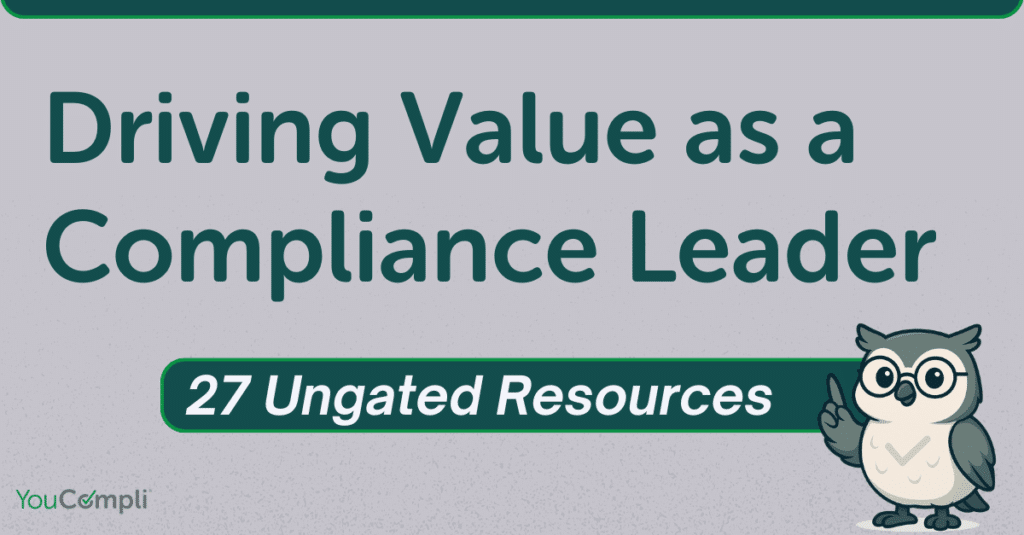
Compliance professionals sometimes feel undervalued in comparison to other functions in their organization. They think leaders and colleagues don’t really understand what they do.
These resources will help. Packed with ideas, tips and recommendations, these pieces were written by professionals with many years of compliance experience.
You can quickly skim for articles that relate to your needs and interests. Bookmark this page as a reference for future questions or projects.

It’s the nature of our mission to stay on top of what’s happening in the world of healthcare compliance. And right now, that focus couldn’t be more important.
These are unusual times, and Compliance is feeling the impact. The Medicare Fiscal Year 2026 Final Rules were expected to be late but came through on time. However, hospitals must still rush to analyze and respond with action plans in short order. CMS transmittals are also likely impacted by the government shutdown (more on that later).
That leaves many hospital compliance teams unprepared and under-resourced to cope with fast-coming changes. The price of noncompliance, even under extenuating circumstances, is reimbursement risk.
The CMS guidance for healthcare comes with its own deadlines attached, and every year there are two important and separate timelines for fiscal year and calendar year Final Rules.
In healthcare, fiscal year guidance typically has an October 1 effective date, and that Final Rule usually drops in August. This year, YouCompli analysts got through the fiscal year Final Rules incredibly quickly, because CMS cut a lot of the material in the preamble, and that allowed more efficient review and analysis.
As every seasoned compliance professional knows all too well, CMS puts out a handful of big, omnibus rules for different areas of health care on an annual basis. This time of the year brings us the final rules affecting outpatient costs and billing. These areas usually get addressed during the calendar year, and these calendar year communications started dropping this year on November 5. That gives an effective date of January 1 of the next year.
It’s important to get these annual changes synthesized and implemented in a health care organization because they cover the entire year. Even when Rules drop at the usual time (and not during a government shutdown), the short time frame to the established effective date still puts pressure on providers to analyze and develop a compliance action plan. That’s where having a partner like YouCompli already breaking down these rules and translating them into actionable business requirements is essential.
On top of concerns about Final Rules delays, CMS transmittals ceased to come out on September 30. Transmittals are typically issued on a running basis as they come up. In a given month, you can have anywhere from 15 to 150 transmittals come out.
A CMS transmittal is not the same as a Final Rule. They are two distinct types of guidance documents from the CMS. Transmittals are official documents to communicate new or changed policies, procedures, claims and other operational guidance to Medicare administrative contractors (MAC), regional offices, and healthcare providers. The communications update specific CMS program manuals, instructions, and other documentation to ensure consistent implementation of Medicare rules.
Another job of a transmittal is to direct the MACs on what to do in processing claims. These third-party contractors are hired by CMS to administer claims, and they can get backlogged on their instructions and claims processing when transmittals run late.
Any claims processing delays impact providers, so it’s important to keep an eye on when these transmittal communications come out, especially if it drags out for weeks. If MACs struggle with claims processing because they can’t keep up with the updates, providers lose money.
Whether it be through time-related loss, because then they have to reissue claims with fixes and things of that nature, delays directly impact revenues. That’s not good at a time when health systems are already under the gun.
If you’re a YouCompli customer, you wouldn’t have to scramble to prepare for last-minute changes, because we would handle it.
If communications are ever delayed, creating a time crunch, let us act as your analysist team, grabbing communications as soon as they come out, and breaking it down for you. We capture the necessary data and deliver it, along with easily understandable business requirements.
You’ll know what you need to do to comply, so when the next Final Rule or transmittal hits your inbox, you’re ready to run with updating procedures, training and other requirements.
We suggest getting on board with us now, so when that time comes, you’re not struggling with these risks and delays.
About the Author
Nate Ward, J.D. is the Manager of Compliance and Content Development at YouCompli Software. He comes from a deep background in healthcare compliance and the legal field. Nate leads a team of experts who read regulations, analyze how they apply, and recommend action plans for healthcare compliance.

Compliance professionals sometimes feel undervalued in comparison to other functions in their organization. They think leaders and colleagues don’t really understand what they do.
These resources will help. Packed with ideas, tips and recommendations, these pieces were written by professionals with many years of compliance experience.
You can quickly skim for articles that relate to your needs and interests. Bookmark this page as a reference for future questions or projects.

“Compliance professionals at nursing facilities and their business partners should regularly study the ICPG as they continue their compliance efforts.”
Continue reading
CEO Jerry Shafran has prepared a festive video to help us wrap up the year. We wish you a safe and happy Holidays and New Year!
Continue reading
“Whether you are new to the field or a seasoned professional, hopefully the viewpoints offer insight that can influence your BOD’s understanding of their oversight responsibility for the compliance program.”
Continue reading
“By taking a practical approach to this complex topic, you will be viewed positively by your team and able to respond well to questions about AI risks from your business partners, the C-suite, and your Board of Directors.”
Continue reading
“Compliance officers can make the most of the new GCPG to meet the requirements of the OIG’s seven elements in a relevant and meaningful way.”
Continue reading