
New to healthcare compliance? Find practical resources on communication, audits, regulatory change, and program oversight, organized by the work you need to learn.
Continue reading
New to healthcare compliance? Find practical resources on communication, audits, regulatory change, and program oversight, organized by the work you need to learn.
Continue reading
AI is moving faster than healthcare policy can keep up. For compliance leaders, the knee-jerk reaction might be avoidance, but blocking AI isn’t an option.
Continue reading
Healthcare compliance leadership requires choosing between the “hard” of stagnation and the “hard” of growth. This post by John R. Nocero and Andrea L. Bordonaro explores how to move beyond basic regulatory tasks toward strategic Revenue Integrity and Operational Excellence.
Regulatory compliance leadership isn’t for the faint of heart. Every day, leaders in our field face a fundamental choice that dictates the future of their organizations and their careers. It’s a choice between two distinct types of “hard.”
One path leads to a plateau of administrative burden, while the other leads to a breakthrough in operational excellence. To move the needle on key compliance metrics, you must decide which challenges you’re willing to embrace.
Regulatory change rarely lives in one department. It touches:
Someone must translate regulatory language into operational tasks that those teams can execute. That translation step is where many organizations struggle. Well, guess what? You’re the translation step.

Someone must translate regulatory language into operational tasks that those teams can execute. That translation step is where many organizations struggle. Well, guess what? You’re the translation step.
The compliance professional’s goal is to move metrics. Period. Whether it’s an outcome of no findings during a state inspection, ensuring everyone is signed off on education and training modules, or the weekly operational numbers posted for the entire organization to see, it’s your responsibility You know the work needs to happen. The challenge is getting the organization aligned around it. And that’s hard.
Your organization’s leaders trust you to handle it, and they probably see you as capable of doing more. This visibility is an advantage, especially if you want to move up in the organization. But be aware, because corporate and everyone else is watching, looking for cracks in the armor or making you out as the target.
Our advice? Choose your hard. Here’s how.
We all want an easier professional life. Less stress from daily meetings. More happiness from the validation of receiving praise from a job well done. Fewer complications from multiple people coming to your door every day to solve problems that aren’t yours.
Here’s the truth nobody likes to admit: There’s no easy path. There’s only a choice between hard options. So, choose wisely.
As we see it, you have two options:
This isn’t difficult. You’re basically choosing to do the same things you’ve been doing in the same manner. Keep leading the daily morning compliance meeting in the same style. Keep walking through the units waving and shimmying around but not really being authoritative or looking for issues. Talking to employees but not finding anything out, just basically wasting time.
And please, avoid the hard conversations around people constantly interrupting you with their problems instead of doing what you get paid to do.
This is hard, but not for the reason you think. This is hard because, well, we know you, you’re busy, but not productive. You are seen, but you aren’t really doing anything. You think you’re managing, but you’re really just walking around.
You also think you should be promoted and moved up for doing what you’re supposed to do.
Here’s the hard truth. You don’t get credit for the things you’re supposed to do. If you’re supposed to lead orientation, write policies, make presentations, all that is in your job description. It’s a basic function of your job. You’re not getting additional credit for that. You get credit for moving the needle, not stagnation.

This version will feel easy in the moment. But over time, it becomes a cycle. Anxiety creeps in. Stress builds quietly. Communication gets messy. You start telling yourself little lies to stay comfortable. You get moments of happiness, but they don’t last because they’re built on escape, not stability.
When a compliance department functions as a separate silo rather than a strategic partner, the friction is constant. You’re working hard, but you are not working toward a breakthrough. You are merely surviving the administrative weight of healthcare regulations.
The alternative is the “hard” of growth. This involves the difficult work of Revenue Cycle Management (RCM) integration, fostering cross-functional alignment, and ensuring that compliance is viewed as a driver of healthcare quality and patient safety.
It takes discipline to move beyond the checklist and into this strategy. It’s “hard” because it requires changing the culture of an organization, but it’s the only path that leads to:
Cut the noise. Reduce the dopamine overload. Sit with discomfort instead of running from it. Say the hard things. Build better habits. Run different meetings. If your boss is giving you a directive that you have to go and talk to the director of nursing and get his or her staff to carry out a particular order, don’t walk up to them and go “Hey, boss, wants you to do this” and tell them exactly the same order that was told to you. That’s not changing. That’s parroting.
You need to do that a bit differently, such as “boss wants your team to do XYZ. Do you know how to do this? Does your team know how to do this? What are the gaps? What can I do for you right now?”
See the difference? It’s subtle, but effective. Basketball fans can think of it as the difference between telling your basketball team to run the triangle offense and perfecting the triple-post with all your front court repeatedly until it’s second nature, creating multiple scoring options based on defensive reactions. When you repeatedly do the hard thing, it pays off over the long term.
This hard path is uncomfortable, and at first, it feels worse, not better. It’s hard to sit in the discomfort. But over time, something starts to change. Your brain slows down. Your emotions stabilize. You stop needing constant stimulation just to feel okay.
And one day somewhere down the line, you realize: You’re not chasing happiness anymore or trying to be the part. You don’t need to wear a three-piece suit to the corporate board meeting. You can wear a Roman Reigns OTC crewneck. You don’t have to pretend to be the part. You are the part. And you are just experiencing it.
The tricky part about Option 2 is that it doesn’t feel like it’s working at first. That’s where most people quit. Option 2 is harder. But it compounds. It’s the difference between escaping your life and actually building one you don’t need to escape from.
Be a long gamer because taking the “easy” path now often becomes the hardest life later. And the hard path now? That’s the one that sets you free.

Andrea has taught first grade in Willoughby, Ohio for 27 years in the same classroom that she attended school as a child. She earned a Bachelor of Science in elementary education with a minor in language arts from John Carroll University and a Master’s Degree in the Art of Teaching and Education from Marygrove College.

John builds and fixes quality departments, while currently thriving as the Administrator & Director of Quality, Risk Management and Compliance at River Vista, a behavioral hospital in Columbus, Ohio.
The Q-Kids – John R Nocero and Andrea L Bordonaro – are experts at everything quality, regulatory, education training and compliance and love sharing their knowledge on YouCompli.
Follow them on LinkedIn – for more quality content or send them a message – they’d love to hear from you.
Video resource hub

For years healthcare leaders have been faced with demonstrating their value and answering the question, “How is compliance doing?” Getting the answers typically involves a scattered, manual process of pulling data from multiple sources, departments, and teams, then going through the process of aggregating that data to pull important, need-to-know information. By the time that step is complete, often the information is already out of date.
Continue reading
In this article, Lisa Estrada shares her perspectives on why systems beat heroes in compliance and how AI can help accelerate systems thinking in fast-paced healthcare environments.
Continue reading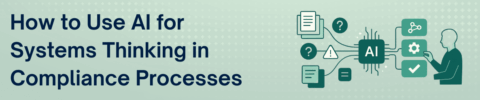
Artificial intelligence is beginning to reshape the compliance landscape, but the field is still in the early stages of adoption. Compared with other business functions, compliance has been slower to embrace AI, especially in healthcare, where concerns about risk, regulation, and potential bleed-over into clinical decision-making have made organizations particularly cautious.
Yet the opportunity is substantial, especially when it comes to systems thinking.
Effective compliance programs depend on systems thinking. Rather than viewing each request for guidance, investigation, or remediation as an isolated issue, savvy compliance teams look at how individual problems fit into larger patterns.
One of the challenges in any business function is the tension between individual heroics and well-designed systems, and, ultimately, systems win every time. Many compliance officers have been conditioned to act like lifeguards, diving in to save departments from themselves. But this reactive approach consumes time and limits impact. You stay busy, but the organization doesn’t necessarily become more compliant.

Shifting away from heroic interventions requires time, strategic thinking and structural planning, resources that compliance professionals rarely have in abundance. This is where AI becomes a powerful ally.
The key to building proactive compliance is carving out the mental space to think more broadly about operational processes. AI doesn’t replace human expertise, but it can significantly accelerate the work.
AI tools can analyze the countless issues compliance teams handle daily and help generate system-level recommendations. Think of AI as a partner that gets you to the 50- or 60-yard line, far enough to give you a strong foundation, but still requiring human judgment to complete the plan.
The first step is identifying patterns:
Once you see the trends, you can begin imagining the systems that will address them. AI excels at helping structure these ideas.
A practical way to start is by giving your AI assistant raw input:
Then you can prompt the AI with something like:
“I want to build a system to help identify and minimize these risks within a complicated environment. What elements should be included, and what considerations fall under each element?”
The output becomes a foundation, a map of decision points and organizational steps you can refine.
Compliance work is complex, and many officers get stuck not because they lack insight but because they lack time. AI helps break the gridlock by organizing information, highlighting key considerations, and suggesting frameworks.
The AI provides structure; the compliance professional brings subject-matter expertise. In this collaborative process, the AI’s suggestions spark additional ideas and help you think more holistically. The result is a level of systems thinking that becomes far more accessible even in hectic environments.
Despite its power, AI cannot replace an experienced compliance officer. It draws from online information and from what you feed it, but it cannot grasp organizational nuance, personalities, or culture.
For example, an AI may outline a solid system, but only the compliance officer understands how a skeptical executive will respond. That’s where the human element comes in. You can ask the AI to help tailor communications or anticipate objections, but the strategic decision-making remains yours.
One of the hidden challenges of compliance work is staying focused long enough to complete long-term system projects. Urgent tasks constantly pull attention away, and partially built frameworks can easily get lost for months.
AI-created structures help maintain focus. They provide guardrails, the methodological anchors that keep the conversation and planning on track. Most of the framework can often be developed in a single sitting, creating a roadmap you can return to even if you’re pulled into other issues.
Even with the limitations of some AI tools, especially free versions that cap conversation length, paid versions make it easier to resume discussions, refine ideas, and maintain continuity.

Compliance professionals work hard and add value every day, but much of that value is short-term because they lack the time to build the long-term systems that create lasting change.
AI solves this by offering a “faster roadmap to a roadmap.” It accelerates the groundwork:
That clarity frees the compliance officer to focus on the human side of adapting the system to the organization, navigating culture, and communicating effectively with leaders.
With an AI-driven framework, compliance work becomes more disciplined, efficient, and proactive. Systems thinking becomes not only achievable, but sustainable. AI doesn’t replace the expertise of compliance professionals—it elevates it.
Compliance professionals sometimes feel undervalued in comparison to other functions in their organization. They think leaders and colleagues don’t really understand what they do.
These resources will help. Packed with ideas, tips and recommendations, these pieces were written by professionals with many years of compliance experience.
You can quickly skim for articles that relate to your needs and interests. Bookmark this page as a reference for future questions or projects.

Risk comes in many forms . Financial. Patient-related. But the biggest unforeseen risk to me is reputational. If you don’t have a reputation for offering the best patient care while keeping people safe and patients receiving benefits from treatment, you won’t be successful. You won’t make money. You won’t care for patients. You need to see it. Firsthand.
Continue reading
In every organization there is a moment where the quality department becomes either the trusted operational partner or the operational roadblock. The difference tween the two comes from how you communicate, assign responsibility and how you follow through. This blog explains how to adopt the OG style for more effective quality programs in healthcare.
Continue reading
In this blog, experts offer the real scoop on audit readiness in healthcare. Learn the unfiltered truth about compliance audits and what audit etiquette means. Get essential tips on preparing for audits, the role of healthcare compliance auditors, and what to do (and what not do) during an audit.
Continue reading